Emmonak Tank Farm · Qiilituliq, LLC
Bulk fuel, repair parts, convenience items, and delivery and repair services for the community of Emmonak and the Yukon Delta — operated by Qiilituliq, LLC, a wholly owned Emmonak subsidiary at its own location separate from the Company Store.
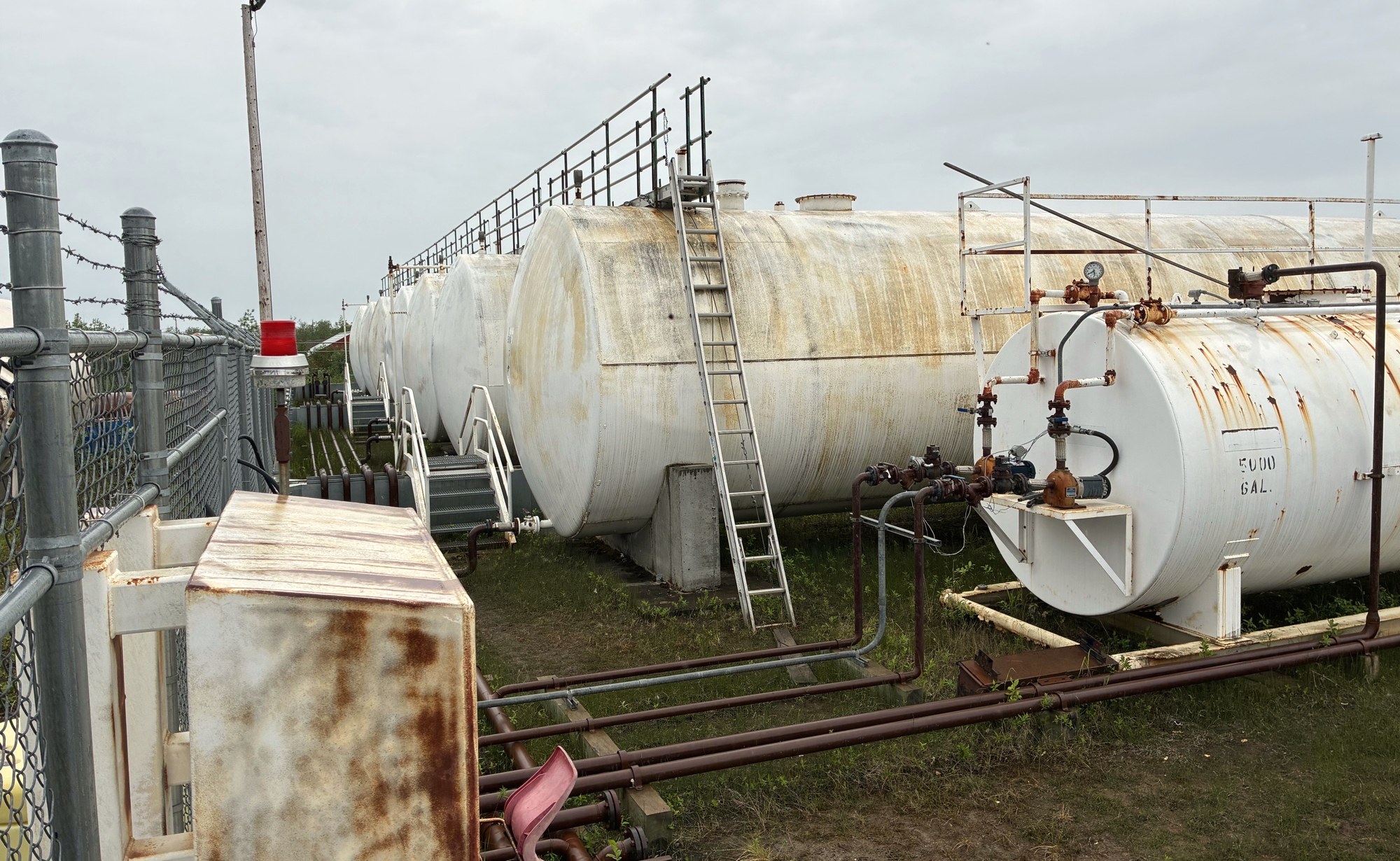
Energy security in Western Alaska is measured in gallons of stored fuel. The Emmonak Tank Farm holds the reserves that heat homes through a months-long winter and power the boats, machines, and generators a river community runs on.
Capacity includes 200,000 gallons of gasoline and 150,000 gallons of heating fuel, alongside propane distribution. Alongside fuel, the Tank Farm site stocks repair parts and convenience items for fuel customers, and operates residential and commercial delivery and repair services across the Yukon Delta.
The Tank Farm is operated by Qiilituliq, LLC — a wholly owned Emmonak subsidiary — at its own location separate from the Company Store. Order fuel, parts, convenience items, and services online for pickup or delivery.
Gallons gasoline capacity
Gallons heating fuel capacity
Regulatory posture in progress
Operating a bulk fuel facility on the Yukon River means answering to more than one regulator. Below is the full picture of what applies to us, why it applies, and where we are in standing up each program. Every item is marked In progress as a policy baseline; individual items move to Active as each document is certified by the appropriate authority.
Spill Prevention, Control & Countermeasure Plan (SPCC)
What it is: A written, PE-certified plan describing spill prevention, secondary containment, inspections, training, drills, spill response, and reporting for facilities with aggregate aboveground storage above 1,320 gallons. Reviewed and updated every five years.
How it applies to us: Our Tank Farm exceeds the 1,320-gallon threshold with 350,000 gallons of aggregate aboveground storage (200,000 gasoline + 150,000 heating fuel), plus propane distribution. A licensed professional engineer–certified SPCC Plan is being prepared and will be kept at the facility and available for EPA inspection.
Facility Response Plan (FRP)
What it is: A response plan for non-transportation-related onshore facilities that could reasonably cause substantial harm to navigable waters. Applies to any facility that transfers oil over water to or from vessels and has ≥ 42,000 gallons of storage capacity. Includes worst-case discharge scenario, response resources, and training.
How it applies to us: Our Tank Farm receives fuel by barge from the Yukon River and holds well above the 42,000-gallon threshold, so the FRP is required. Preparation and EPA submission are underway; the plan will be exercised through the required drills once approved.
USCG Facility Operations Manual & Letter of Intent
What it is: Marine transfer facilities (MTR) must file a Letter of Intent to Operate with the Captain of the Port and maintain a Facility Operations Manual describing transfer procedures, containment equipment, communications, lighting, and emergency shutdown. Personnel involved in transfers must be trained and documented, records retained for at least three years.
How it applies to us: Barge-to-shore fuel transfers at our marine header trigger USCG jurisdiction. The Letter of Intent and Operations Manual are being finalized for submission to USCG Sector Anchorage. Transfer-personnel training records will be maintained on-site.
ADEC Class 2 Facility Registration
What it is: State registration for non-crude oil storage facilities between 1,000 and 420,000 aggregate aboveground gallons. Includes a Class 2 Facility Registration and Notification Form, state discharge notification placarding, and adherence to Alaska oil pollution prevention regulations (18 AAC 75.005 – 18 AAC 75.496).
How it applies to us: At 350,000 aggregate gallons, our Tank Farm is a Class 2 facility. Registration paperwork and the ADEC-approved discharge notification placard are being finalized.
Fire Marshal approvals for tank installation & change
What it is: The State Fire Marshal must approve installation and any change of fuel storage tanks before work is started. IFC 2015 secondary-containment sizing (largest tank + 25-year/24-hour storm event) is enforced.
How it applies to us: Any future capacity expansion or tank replacement at the Tank Farm will be routed through the Alaska State Fire Marshal for prior approval, and current secondary containment will be measured against the IFC 2015 storm-event standard as part of the SPCC engineering review.
HAZWOPER Personnel Training
What it is: Hazardous Waste Operations and Emergency Response training for personnel involved in oil-spill response and cleanup activities. Includes an initial 24- or 40-hour course based on role, an 8-hour annual refresher, and documented on-the-job supervision.
How it applies to us: All Tank Farm operators and spill-response staff have completed HAZWOPER training and annual refreshers. Training records are maintained on-site as part of the SPCC and FRP training programs.
Permit-Required Confined Space Entry
What it is: Written permit program for entry into any confined space at the facility — including tank interiors during cleaning, inspection, or maintenance — with attendant, entrant, and rescue procedures.
How it applies to us: Tank cleaning and internal inspection are permit-required confined-space operations. A written confined-space entry program is in development and will be linked to the HAZWOPER training program.
Hot Work Permit Discipline
What it is: Written hot-work permit system for cutting, welding, or brazing anywhere near stored fuel. Includes fire watch, atmospheric monitoring, and hazard control.
How it applies to us: Every welding, cutting, or grinding activity at the Tank Farm will require a written hot-work permit under a facility-specific procedure that ties to the SPCC Plan.
AST inspection to a recognized national standard
What it is: Aboveground storage tanks must be inspected on a recurring cycle to a recognized industrial standard — API 653 for large field-erected tanks, STI SP001 for shop-built tanks — with formal reports retained.
How it applies to us: Formal AST inspections have been completed for the gasoline, heating fuel, and propane tanks. Reports are kept on file at the Tank Farm office.
Annual hydrostatic pressure test of marine transfer piping
What it is: Marine transfer piping must be hydrostatically pressure tested prior to the first fuel delivery of each season, and results retained. Barge Declaration of Inspection (DOI) and pre-transfer meeting are required for every transfer.
How it applies to us: Annual pre-season pressure testing has been completed and documented. Declaration of Inspection forms and pre-transfer meeting logs are retained as part of the USCG-compliant transfer program.
Emmonak Corporation and Qiilituliq, LLC treat regulatory posture as public information, not a private compliance file. This page lists every framework that applies to us and where each program stands. If you are an ADEC, EPA, USCG, or State Fire Marshal representative and need current documentation, please contact us at tankfarm@emmonak.com.
Hazmat, OSHA, and DOT placarding
A properly labeled fuel facility is the fastest way for a first responder to understand the hazard. The Tank Farm carries the required NFPA 704 hazard diamonds on storage tanks, USDOT hazard-class placards on bulk transport and dispensing equipment, and state and federal discharge-notification placards at the facility perimeter and marine header.
Diamond placards will be posted on the exterior of every fuel storage tank and enclosure. Gasoline: 1 · 3 · 0. Heating fuel (No. 1/No. 2 diesel): 0 · 2 · 0. Propane: 2 · 4 · 0 (special: SA).
Class 3 red-diamond placards on all bulk transport vehicles and dispensing points for gasoline and fuel oil.
Class 2.1 red-flame placards on propane storage and any propane transport equipment.
State-approved discharge notification placard listing the operator, phone number, and ADEC/USCG reporting contacts, posted at the facility entrance.
USCG-approved reporting placard for oil discharge to navigable waters, posted at the marine transfer location.
A capability we plan to share with the Yukon Delta
Every certification listed above becomes an operational capability we plan to offer to other villages and operators across the delta — not because we have to, but because the training and equipment are already here and the need across the region is real. As each program moves from In progress to Active, the matching service opens up.
HAZWOPER response support
Once our operators are HAZWOPER-certified and drilled, we plan to make oil-spill response support available to other operators across the Yukon Delta.
Confined-space entry program
A trained confined-space team allows us to offer tank interior inspection, cleaning, and permit oversight to villages that don't maintain their own program.
Pressure testing & tank inspection
Hydrostatic pressure testing of marine transfer piping and AST inspection support for other village tank farms.
SPCC & FRP consultation
Once our own plans are certified and exercised, we plan to help other small facilities meet the same standard — a real gap for many delta villages.
Tank cleaning
Wet and dry tank cleaning services delivered under our confined-space and HAZWOPER programs.
Annual required-training delivery
Once our training program is documented, we plan to deliver required annual refresher training locally, so delta operators don't have to travel.
Online ordering — coming soon
The Tank Farm will support online ordering for fuel, parts, and convenience items once our back-office fulfillment system is live. The catalog and cart preview below shows how ordering will work. To place an order today, contact the Tank Farm office directly — the team will confirm availability, current pricing, and pickup or delivery.
The catalog, cart, and checkout flow below show how ordering will work for the Emmonak Tank Farm — operated by Qiilituliq, LLC. Online submission is not yet active while our back-office fulfillment system is being built. Until then, please use the direct contact information on this page to place orders — our team will confirm availability, current pricing, and pickup or delivery details.